During the last part of the winter of 2006/07, the Flagpole developed a precarious lean during a storm.
Les Leonhardt and Paul Carter fashioned a temporary support system to prevent further damage.
June 4/07, Peter Case asked me to have a look at the flagpole to determine if the fibreglass base could be repaired.
June 6/07, flagpole was lowered after splitting the rusted nuts on the hold down bolts and the flagpole was moved to the pavillion, with the assistance of Paul Carter and George Mulholland.
.jpg)
June 9/07, Ted Thomas, all by himself, brought the flagpole to the orchard and photos were taken of the damaged base and published on the club’s website.
Observations#1 Jack's flagpolehas been standing for 30+ years without any maintenance with the exception of raising a new flag each year and replacing the halyard several times during this time period.
An excellent testimony to Jack’s fibreglassing abilities. .jpg)
#2 Base has suffered damage from snow, impact damage from lawnmowers, animals?, etc and is in very poor condition.(A suggestion would be to make a flower bed, etc. around the base of the flagpole to keep lawn cutting machinery from getting too close to the structure).
.jpg)
#3 Although the actual flagpole is in reasonably good shape, fibreglass strands are starting to show through the gelcoat(?) from ultraviolet damage but should be able to be restored to good condition with 2 coats of a good fibreglass paint (Interlux?). (See note re ASSmosis)
Another example of Jack and Norma's handiwork was the flagpole that adorned the St. Marys water tower. The following is a brief comment on that flagpole from Don Van Galen,
"The flagpole on the water tower was a payton fibreglass mast. approximately 28 feet high. In high winds it broke off about mid point. Originally it was thought that it could be repaired by using an insert and re glassing. However it was not a clean break, the rest of the mast was shattered internally as well, and it could not be repaired. It was replaced with 2 aluminum poles welded end to end. Cost a few hundred dollars. Basicly, purchase cost for 2 poles at steel yard plus welding".
Don Van Galen (Feb. 17/09)
The flagpole atop the water tower was probably subjected to much higher winds than our flagpole, in its sheltered location, but another possibility of failure might be damage to the resin from ultraviolet rays from the sun once the original gelcoat(?) was broken down.
In my opinion, it is essential to protect the resin from ultraviolet rays with a good coat of fibreglass paint.
ASSmosisMore information on the breakdown of the resin.Owners of KERRY DANCERS and FLYING CANUCKS have encountered a curious malady-FIBREGLASS ASSMOSIS. Besides enjoying the obvious pleasures of owning one of Jack Payton's creations, these owners also experienced an interesting feature of their crafts. After approximately 10 years, these sailors and crew would experience an itching sensation and often feel they have slivers from sliding around on the seats of their boats. The only remedy for this affliction is a fresh coat of paint on the topsides of their boat as the direct rays of the sun have broken down the resin and exposed the fibreglass strands which are now showing thru the gelcoat. Our KERRY DANCER topsides have been painted twice in the last 30 years.Back to the flagpole, which has been exposed to the elements, not for 6 months a year like a boat but has been out in the sun's rays for 12 months every year and will have experienced a much greater deterioration of the gelcoat.SO, prior to applying two coats of good quality fibreglass paint, I am also recommending applying several coats of resin to strengthen the flagpole.
(FOR ENGINEERS ONLY)One question that was always a mystery to me was that since most sailboats have an aluminum mast, how did Jack&Norma construct a fibreglass mast that was light, flexible yet strong enough to stand up to the rigors of sailing on a KERRY DANCER and a CANUCK?
.jpg)
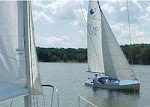
Our KERRY DANCER with its fibreglass mast that was recently painted with AWLGRIP 2 part urethane and looks as good as the day it was made!!
And how did they ever manage to create a flagpole over 35 feet in length that would stand up to the extremes of weather that we have in Southwestern Ontario?
.jpg)
Norma let me in on the secret when she brought out a box of fibreglass rope and a roll of fibreglass mat.
The masts and the flagpole were constructed on a cardboard tube of the required length.
The fibreglass rope was attached to the outside of the tube at one end and then strands were run to the other end, around a pin, and then back down to t
.jpg)
he starting end, around a pin and then back to the other end as many times as necessary to provide a suitable framework for resin.
Resin was then applied, working it well into the fibres so they were completly saturated and then the pole was finished with a final coat of resin, with colour added.
And that in a nutshell is the secret of a fibreglass mast/flagpole.
Jack certainly was an innovator and a master of working with fibreglass.#4 The base hold-down straps (actually strands of fibreglass rope) have deteriorated (obviously the weak link in the system) and are broken, which caused the flagpole to develop the precarious lean.
.jpg)
#5 The side panels of the base have deteriorated beyond repair as they were made from very thin fibreglass cloth. Actually the paper used as a form for the side panels was still inside the base.
.jpg)
#6 The bottom of the base was in better shape as fibreglass mat was used in its construction.
#7 The hold-down studs(actually mild steel- threaded rod), embedded in the concrete pad, were in reasonably good condition after a 3/8"-16T.P.I. die was run down them. Suggest using stainless steel washers and cap nuts on new straps.
#8 The closed design of the base renders repairs impossible as it is not possible to do internal repairs to the base without cutting access holes in the side panels necessitating repairs to close in the access holes.
#9 The ability to detach the base should not be overlooked as when repair or maintenance is required on the base it is so much easier to remove the base for transport than having to deal with a 35' long structure.
July 8/07, Discussed repairs to flagpole with Norma Payton (she was really interested in photos of flagpole) at the W.S.C. OPEN HOUSE EVENT and stated she would be glad to offer her
advice on flagpole repairs.
June 9/07, Peter Case dropped into the orchard and the flagpole repairs were discussed for approximately 1 hour.
Discussed with Peter the possibility of making an internal frame for the base out of stainless steel and using stainless panels on the sides.
Peter’s comment was that since I have lots of stainless steel at the orchard, I should try to make a new base.
The conclusion of our discussions was that it was futile to attempt to repair the base and a new base was required.
P.S. The flagpole has been under cover since delivered to orchard (in our driving shed)
P.S. Since the flagpole is over 35' in length and fibreglass repairs should only be attempted when the temperature is above 60F, repairs to the fibreglass can only be done in the summer when the outside temperatures are above 60F.
P.S. A detachable base would allow repairs to be made without having the challenge of transporting the 35'+ flagpole.
Lorne Mulholland
Oct. 28/2008 (Report submitted to Commodore Jim Phillips for discussion at Executive meeting).
Jan.16/09 Jim phillips asked me to contact Peter Case and George Mulholland to formulate a plan to have repairs to the flagpole accomplished at a maximum cost of $300.00.
Feb.04/09 After discussions with Peter Case and George Mulholland, we decided the next course of action would be to put the flagpole information on the W.S.C. website for input from the members.


.jpg)
.jpg)
.jpg)
.jpg)
.jpg)
.jpg)
.jpg)
.jpg)


