"Design is a search for the appropriate.
The options are endless, and they all make at least some sense.
But the time comes when you have to sit down and say, "It’s going to look like this" - when the gestalt of everything you know or think you know leads you to what you feel is most appropriate."
From RIGGER'S APPRENTICE by BRION TOSS
The options are endless, and they all make at least some sense.
But the time comes when you have to sit down and say, "It’s going to look like this" - when the gestalt of everything you know or think you know leads you to what you feel is most appropriate."
From RIGGER'S APPRENTICE by BRION TOSS
"Nothin' too strong ever broke" -Maine proverb
Also from RIGGER'S APPRENTICE by Brion Toss
One of the first suggestions was that if Jack's flagpole could not be restore
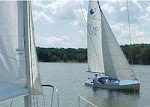
 d, we should come up with a support base that (similar to this photo) would allow the flagpole to be lowered for maintenance.
If we proceeded with this concept, we could possibly use Mark Rohfrietsch's mast from his "GHOST", if Mark would part with it for a nominal fee.
The concept of a flagpole that could be easily lowered has many advantages. The main one is that it could be lowered for routine maintenance(painting, replacing flag halyard, etc.). Another is that the pole could be more easily transported if the base was not attached.

This is a sketch of a mount made from stainless steel strap (1/8"X1 1/2" wide) that would solve the problem of the weak corners.
Would also solve the challenge of painting mild steel straps on a regular basis.
However the secure attachment of the mount to the pole dictates a challenge(read: expensive) for this mount.

This sketch shows what the mount would look like with stainless steel or aluminiumside covers. At least one side cover should be removable to allow for routine maintenance.

Approximate dimensions of proposed mount.
(If the dimensions are too difficult to read, double click image and it should reappear as a larger photo.)

Sketch using existing fibreglass as attachment points for mount to pole.
Much easier to build and attach to pole but certainly doesn't look as attractive.
This sketch was submitted by Steven Combes.

It exhibits many excellent suggestions.
I particularly like the comment about coating the mild steel parts with epoxy paint in an effort to protect them from the elements.
Also the concept of attaching the support post for the flagpole directly to the plate bolted to the foundation pad introduces a very innovative concept which dictates that the welding done attaching the post to the plate must be of a very high calibre.
A great effort- Thank you very much Steven.

This design held much promise due to its simplicity and the use of the existing anchor rods.
HOWEVER, when the numbers were crunched, the calculations revealed that this design would fail the wind criteria(one major storm in 50 years) and thus, this design was proven to be unsuitable.
Thanks to Steven Combes for performing these very important calculations.
Back to the drawing board.

Here is a sketch based on a concept suggested by Steve Hartfield.
Comments from his e-mail of March 9/09.
Your drawing looks quite feasible. However you may want to note that I used to install 68 foot self support radio towers with my Father. They where set in a block of poured cement 4ft x 4ft x 4ft. That is a lot of cement. I'm sure we could get by with a lot less cement. Perhaps a large sono tube with the pipe centred in cement. A good post hole digger or auger might work in the clay.
Another thought might be a 10 inch post hole dug four feet deep. Galvanized pipe set in the centre surround the pipe with packed sand. No cement at all.
Fair Winds
Another thought might be a 10 inch post hole dug four feet deep. Galvanized pipe set in the centre surround the pipe with packed sand. No cement at all.
Fair Winds
Steve
Thank you Steve for an EXCELLENT suggestion.


No comments:
Post a Comment